

News
Local workshop – ”Endurance” project
Yesterday March 17th, 2026 ANISP participated in the local workshop (Romania) related to the European project “Endurance – Strategies and Services for Enhanced Disruption Resilience and Cooperation in Europe”, funded by the Horizon Europe Program, focused on identifying suitable solutions for strengthening the resilience of essential service ecosystems and critical supporting infrastructures – the strategic approach aimed at increasing the level of awareness and development of resilience skills. The project has a duration of 3 years and includes 23 partners from Europe (research and development centers, authorities and critical infrastructure operators from Romania, Slovenia, Italy and Greece).
The event had a hybrid format (online & physical – at the DNSC headquarters at 22 Italiană Street, Bucharest) and enjoyed a wide audience. The event aimed to analyze the national resilience framework, increase the level of interoperability, develop training programs and stimulate accelerated innovation in the field of critical infrastructures.
Within the workshop there were also presented solutions based on the “Digital Twin” concept, as tools for assessing and monitoring critical infrastructures, along with sectorial perspectives supported by representatives of DNSC, DGPI and the Ministry of Health. The workshop also proposed applied discussions, based on concrete examples from the national experience of operators in critical sectors (e.g. telecommunications, energy, water supply), with the objectives of identifying immediate needs for improving operational resilience processes and exploring solutions for strengthening the resilience of critical infrastructures in a constantly evolving threat landscape.
More details on the project website: https://endurance-horizon.eu/
RITE 2025
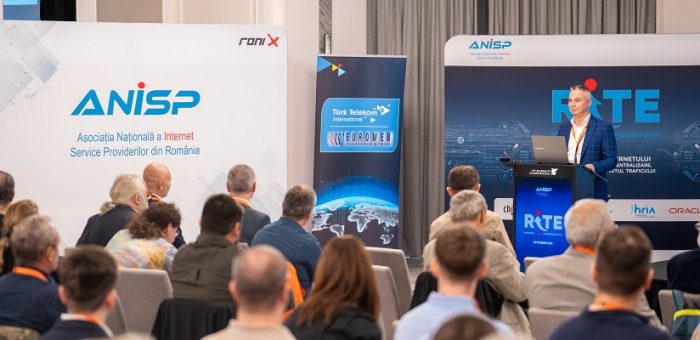
Tuesday, October 28, the 2025 edition of the Romanian Internet Technologies Event took place. After the usual introductory words from the organizers, very interesting sessions followed with the participation of industry specialists.
A special note was given by the participation of Mr. George Sadowski, one of the pioneers of the Internet, who pointed out historical landmarks as well as the development directions – the disruptive technologies of the future.
Presentations and panels aligned with the purpose of RITE followed – facilitating interaction between Internet service providers, content creators and users. The event maintains open dialogue between producers and consumers on fundamental topics of the day, such as Internet technologies and architecture, the evolution of accessible content from simple, unstructured data to accessible multimedia services in the cloud, given that the applications of recent years (AI, Cloud Computing, IoT and Quantum Computing) influence not only the services but also the infrastructure and architecture of the Internet.
More details on the event page.

DNSC Orders 1 and 2 of 2025 (approval of notification requirements and risk level assessment methodology, respectively) have entered into force
After being launched for public consultation on April 30, 2025, the following DNSC orders were published in the Official Gazette and entered into force yesterday, August 20, 2025:
- DNSC order for approval of the requirements regarding the notification process for registration and the method of transmitting information ( https://legislatie.just.ro/Public/DetaliiDocument/301473 )
- DNSC order for approval of the criteria and thresholds for determining the degree of disruption of a service and the methodology for assessing the risk level of entities ( https://legislatie.just.ro/Public/DetaliiDocument/301475 )
More details about the NIS-2 legislation here: https://www.dnsc.ro/pagini/legislatie-nis2
Following the entry into force of the above mentioned orders, entities to which NIS2 applies are obliged to notify DNSC within 30 days. DNSC will confirm receipt of such notification within 5 days.
DNSC will subsequently analyze the notifications received (this process will likely take several months, as there will be many notifications sent quasi-simultaneously during this initial 30-day period). Where necessary, DNSC will also request additional details from the respective entities.
Other steps:
- For each entity that has notified the Directorate, DNSC issues the corresponding decision of qualification (or not) as an essential / important entity;
- Subsequently, for important / essential entities, the respective legal obligations arise;
- The entities thus designated assess their risk level, according to Order no. 2/2025. Each entity will self-assess its maturity level (applicable requirements vs. reality – “gap analysis” – and will draw up a plan of measures for alignment with proper security requirements;
- Following implementation of the aforementioned plan, the obligation to conduct an external audit arises. The list of certified auditors can be found on the DNSC website (https://www.dnsc.ro/pagini/auditori-de-securitate-cibernetica ).

May Romanian Telecom market trend be reversed?
On 29th of May 2025, the “May Romanian Telecom market be reversed” event was organized in Bucharest by ISOC Romania Chapter, ANISP (Romanian Association of Internet Service Providers) and Interlan association.
This was the first ever event organized in Romania on a sensitive subject in our internal telecom market today: the decrease of competitivity leading to a lower Internet resilience in Romania. The one day event was based on the results of Internet Society Pulse statistics for Romania:
https://pulse.internetsociety.org/en/reports/ro/
The same trends were also visible from the ANCOM statistics (ANCOM – The National Authority for Administration and Regulation in Communications):
https://sscpds.ancom.ro/ro/communications/rapoarte-statistice
In some previous international events, organized or co-organized by ISOC Romanian Chapter, like RONOG 2023 & RONOG 2024 and also RITE 2023 and RITE 2024, this subject was already mentioned during the events’ round tables or partially in the Q/A sessions. But this was for the first time when a full event was dedicated to the topic, taking the advantage of ISOC Pulse statistics country results for Romania. Also, the independence and prestige of Internet Society as a Global and Neutral Non Profit Organization working to keep the Internet open, secure and accessible to everyone was very important for pushing this event to both media & authorities attention.
The event organized at the JW Marriott Grand Hotel in Bucharest was also attended by other associations from the IT&C industry, the main providers of electronic communications services, journalists especially from the IT and economic spheres, as well as representatives of the authorities with competence in the field of competition and electronic communications. An unusual fact – representatives of ANCOM, the institution with the most important role in regulating the domestic market of electronic communications services – did not have a point of view on the debated issue, although providers of electronic communications networks and services have been drawing attention to market concentration (and the undesirable effects deriving from this concentration) for many years. Thus, the Romanian provider that holds a share of approximately 75% of the fixed broadband Internet traffic exhibits behaviors that contradict the ideas of an open, secure and reliable Internet. Such behavior is the refusal to peer on mutually advantageous terms on the local market, although peering is a tool of utmost importance for all operators and for the quality of services provided to end customers as well.
This behavior shows that the dominant operator behaves independently of the market, which – combined with the market share held – also constitutes a strong signal in the direction of a conclusion of abuse of dominant position. The independence from the market is obvious – all other Internet service providers choosing to peer through multiple paths (direct interconnections and/or participation in one or even two Internet eXchange points).
Moreover, the refusal to conclude Internet interconnection agreements on equivalent, mutually advantageous bases may indicate the intention to use the size of one’s own network and the users trapped in the network as a barrier to entry for other players. Indeed, according to the statistics of the regulatory authority, the number of Internet providers has experienced a sharp decrease. And if part of this decrease is a natural phenomenon in a free market economy (consolidations, mergers, acquisitions), the fact that no new players appear is symptomatic of the existence of real barriers to entry. This – by the way – is the third criterion, besides the presence of independent behaviors and besides a market share of over 40% – which indicates a possible polarization in the market.
But beyond the competitive market situation – the lack of peering between the dominant operator and other providers certainly undermines the open nature of the Internet, with users finding themselves inside (or outside as the case may be) a “walled garden”, same as happened in the 2000s in mobile telephony networks, before European regulatory authorities imposed the change of traffic to regulated, cost-based tariffs.
It also affects the “secure Internet” character – the Internet being par excellence a network of networks, not a series of small, poorly interconnected islands. By forcing the exchange of traffic far outside the country, IP connections not only lose a lot in terms of latency, but also expose themselves to many additional risks, by increasing the attack surface (man-in-the-middle attacks, DDOS, eaves dropping, compromising the security of equipment along the route, etc.).
An excellent intervention was given by the representative of the Competition Council, who detailed the legal conditions under which complaints can be filed, so that the Council is able to open a specialized investigation. Representatives of the associative environment from industry as well as from civil society recalled the main types of complaints that can be filed, as well as the advantages / disadvantages that arise from each approach. It is also important that even an association, an NGO, can file complaints with the Competition Council, not just a directly injured party.
Also, situations were covered in which the distribution market for audio-visual programs (especially TV, including online TV, OTT, etc.) is strongly affected by the pricing policies of large players, legally unjustified wholesale policies, and the compensation of a sales and marketing service.
During the event, Robbie Mitchell from the Internet Society detailed the data sources and conclusions of the aforementioned study. The presence of Robbie Mitchell on behalf of ISOC as a main presenter in this event, due to his expertise in Pulse statistics presentations, was an important asset, tailoring the event on the main topic and enabling debates from the audience. Valuable Pulse data interpretations regarding Romania and the whole region were very important in this context.
Afterwards, the participants discussed the impact on competition, quality of services and the resilience of the internet, highlighting the causes of the negative aspects and outlining the necessary steps to return to a healthy competitive environment; mainly: the intervention of the Romanian electronic communications market arbitrator (ANCOM) especially to ensure access to the local loop and ensure the interconnection of networks at local level; the revision of the audiovisual legislation to ensure fair competition also with regard to TV or triple-play service packages.
About event organizers:
The Internet Development Association (ISOC Romania Chapter) was created in 2021 with the stated purpose of becoming part of the Internet Society, an international non-governmental organization with over 50,000 individual and legal members, counting over 90 branches around the world, which works to ensure that all people in the world benefit equally from the Internet and openly supports the development and use of the Internet. ISOC Romania Chapter promotes the development of an open, secure, accessible and reliable Internet for all citizens in Romania. The organization aims to support digital innovation, Internet education, protect the rights of online users and reduce the digital divide in disadvantaged communities. It also aims to actively contribute to the formulation of public policies aimed at a free and responsible Internet.
ANISP – The National Association of Internet Service Providers in Romania – is a non-governmental, apolitical, non-profit organization, established in 2001 on the initiative of the most important Internet service providers. ANISP is involved together with the competent state authorities in the elaboration of the necessary policies for the development of the Internet and operates the first Internet eXchange in Romania – RoNIX.
The Interlan Association is a professional, non-governmental and non-profit organization established in 2005 at the initiative of a group of Internet service providers. Currently, the Association has over 50 members, with the aim of supporting and promoting the interests of electronic communications service providers in Romania. The Interlan Association owns and operates the largest national data and internet traffic exchange platform in Romania, InterLAN-IX.
The event was covered by the local press, mass media and on social networks:
https://mediaexpres.ro/articole.aspx?id=21543
https://www.internetmobile.ro/se-poate-inversa-tendinta-pietei-de-telecomunicatii-din-romania/
https://ro.linkedin.com/posts/virgiltruica_telecom-romania-internetsociety-activity-7330163363928264705-tiMy
https://ro.linkedin.com/posts/cornel-barbut-485b9210_telecom-iot-activity-7334165531375091714-zXD_
https://x.com/romania/status/1923350766166618346
https://www.internetsociety.ro/?p=1316
https://www.internetsociety.org/blog/2025/07/community-snapshot-june/

NAV Communications Joined ANISP
NAV Communications has been present on the Romanian IT market since 1997. It started out through partnerships with prestigious local companies, the gained experience allowing it to expand its market share by designing and implementing service packages adapted to the mainstream segment.
The services covered are those of Data Center (colocation / hosting / servers / VPS) – NAV having its own data center in its own building in Bucharest, sector 2. In the year preceding its accession, the company achieved a turnover of approximately 1,804,366 lei and for the current year a growth of 10-14% is expected.
The data center and communication infrastructure were designed by a team of specialized engineers, based on industry standards, without ignoring the need for flexibility of the modern user. Internal operational processes bring major improvements in the service user experience, avoiding the adoption of cumbersome processes specific to the enterprise environment, but without compromising on physical and IT security.
The company prides itself on the fact that ingeniously chosen solutions allow exceeding uptime, performance and security standards, while guaranteeing customers faster business growth, allowing them to make considerable savings in their IT operational budgets.

ANCOM regulates fixed local access services in Digi network
ANCOM regulates access to the Digi network in over 6,200 localities.
The National Authority for Administration and Regulation in Communications (ANCOM) has identified Digi Romania as a provider with significant power in 6,288 localities in Romania, following the analysis of the local access services market at fixed points, at locality level.
In order to ensure effective competition in these localities, ANCOM proposes that a series of obligations be imposed on the operator. Details on the authority’s website:
After the public consultation period, it is expected that alternative providers of electronic communications networks and services will be able to access (in the designated localities) Digi’s local loops under regulated conditions through a reference offer approved by ANCOM.

Romanian Internet Technologies Event 2024
In 2024, ANISP with the support of the Internet Society and the sponsors organizes a new edition of the RITE event, this year the theme is focused on the transformations of the Internet in the age of AI – architecture, services and security.
For details and registration we invite you to the event website!

”INTERNET .RO – HEADING WHERE?” Conference
ANISP participated in the conference ”INTERNET .RO HEADING WHERE IN AI TIMES? – How can Romania return to the global Internet top?”, which took place today, September 18, 2024 at the Grand Continental Hotel in Bucharest.
In the framework of the theme “Digital Transformation Challenges for the Internet Industry in Romania in AI times – Investments, Regulations and Innovation – Analysis of the Internet Industry in Romania, opportunities and challenges” the representatives of ANISP took the floor.
Mr. Adrian Popa, president of ANISP, emphasized the need to treat the infrastructure needed for electronic communications services according to the model of the infrastructure needed for utilities (electricity, water, gas), considering the simplified authorization / construction / intervention regime for these networks.
Mr. Tiberiu Gîndu, ANISP executive director, presented ANISP’s arguments in favor of regulating IP peering with dominant operators that tend towards “abuse of dominant position” behavior, as well as for regulating access to their infrastructure, according to the LLU (local loop unbundling) model already experienced at the level of the European Union.

Total Grup Telecom Joined ANISP
Total Grup Telecom S.R.L. (TGT), represented by Mr. Lucian Bogaciu, Director, joined ANISP.
About the company: Total Grup Telecom appeared on the Romanian telecommunications market in 2005 with the desire to offer professional solutions in the field of designing and authorizing GSM sites. TGT is a company with fully Romanian private capital. TGT’s strategy is to offer its clients services at competitive prices, but above all, top quality.
TGT is an operator of underground telecommunications infrastructures, working currently with three municipalities on this subject (Constanta, Tulcea and Piatra Neamț), looking for new projects requiring such neutral, open and secure infrastructures.

ANISP supports the first national Olympics on fiber optics splicing
ANISP supports organizing – by the Romanian Fiber Optic Association (AFOR) and the WorldSkills Romania Foundation – the first “Fiber Optic Splicing” Olympics in Romania, 10 years after the introduction of this trade in national registry. The Olympics will be hosted by the “Augustin Maior” Technical College of Communications in Cluj-Napoca, after, in February 2024, the contest will be organized at the local level, in each of the 10 participating high schools, for 3 categories: the 10th and 11th grade, high school education and 11th vocational education.
At the national stage, one student from each educational unit will qualify, and the winner of the national Olympics will represent Romania at the International Trade Olympics WorldSkills Lyon 2024 on the Information Network Cabling job that will take place in Lyon in September 2024. Romania’s representative at the national stage he will train together with 4 other colleagues (the next 4 from the national phase) in Bordeaux and Bucharest, who will represent Romania’s national team for the international Olympics.
ANISP contributes to the organization of the Olympics and will respectively provide a prize fund for the 10 students qualified in the national phase.
Other details on the AFOR website and on the project website.